

Fitness influencers talk all the time about how they aren’t always motivated, but they “stay on track” anyways. Let me tell you why that isn’t true.
Discipline, not motivation!
The statements are well intentioned. I’m sure you’ve heard them. “I’m not always motivated. Discipline keeps me on track, not motivation! Look at this super cool video of me deadlifting 300 pounds without any motivation to do it.”
Ok, that last part is a bit exaggerated. But you get what I mean. Personally, I’m guilty of it… I’ll be the first to admit my old bodybuilding Instagram account had some pictures of my (long gone) abs talking about how motivation is fleeting, yada yada yada. Fitness influencers (former me included) love to tell you how they “aren’t always motivated” but they still “do it anyways.” They mean well, but they (and former me) are wrong. They’re just mistaking the feeling of not always liking to put in effort as the feeling of not being motivated to do so; but they ARE motivated to do it, because if they weren’t, well… they wouldn’t be doing it.
This doesn’t mean that discipline has no place in adhering to a workout routine. I’ll never argue that establishing structure in your life and making yourself do difficult things to better yourself isn’t incredibly beneficial; I’m only proposing the idea that motivation, in one form or another, must still always be in the picture.
Let’s get specific.
I’m not in the business of boring my audience, so I didn’t start this article out by giving you the dictionary definition of motivation. Hopefully now, though, you’re sufficiently hooked, so I’ll share these definitions as evidence to support my case.
Definition #1: “the reason or reasons one has for acting or behaving in a particular way.”
So, if motivation is just the reason for doing something, that means that everything we do has motivation behind it. Including every workout we do, meal we eat, glass of water we drink, etc. To say that you don’t have motivation to do something that you are doing is, well, incorrect,
Definition #2: “the general desire or willingness of someone to do something.”
Now, whether or not this definition fully supports my claim could be debated. However, the way I see it, you still have to have desire or willingness to do anything that you do, unless you’re being directly threatened. Even in cases of threat, you’re still willing enough to do the thing to avoid the consequences of not doing the thing… but I digress. My point stands that any human being who goes to the gym, eats healthy, etc. of their own free will is willing to do so.
The many flavors of motivation.
You’ve got your spicy. Sweet. Salty. Sour. Bitter. Umami (I have no idea what that tastes like). Motivation is varied, arguably even more so than flavors; depending on who you ask, there are seven, nine, even eleven different forms of motivation. If any of those motivations come in the flavor sweet, I’ll have five of them, thanks. But with all that variety, why is anyone having trouble staying motivated when there’s such a diverse selection to choose from?
Well, one reason is likely because certain forms of motivation tend to stick around longer than others. I won’t expand on a dozen discrete types of motivation (who’s going to remember all that), but I’ll do my best to break motivation into some overarching themes and explain the pros and cons of each. Hopefully, by the end of this article, you’ll be able to identify how motivation, in its various forms, plays a role in your life, and formulate a plan to make actionable change as needed.
In general, motivation can be categorized as coming from two driving factors:
- Pressure (sometimes referred to as controlled motivation)
- Desire (sometimes referred to as autonomous motivation)
Motivation stemming from pressure, or controlled motivation, has some key subcategories:
- Introjected (pressure coming from you)
- External (pressure coming from an outside source)
As does motivation stemming from desire, or autonomous motivation:
- Identified (desired because it serves your goals)
- Integrated (desired because it’s part of your identity)
- Intrinsic (desired because it feels good)
The last two of those, integrated and intrinsic, are the most powerful forms of motivation, and they deliver the most long-term success. However, generally, all the subcategories of autonomous motivation bring greater adherence than those of controlled motivation.
Back to our fitness influencer friend.
Now, back to that original example; our “Discipline, not motivation!”-happy fitness influencer. As a thought exercise, let’s apply what we now know about motivation to our example of a fitness influencer who:
- sometimes feels like going to the gym (which they consider to be the times that they’re motivated), and
- sometimes doesn’t feel like going to the gym, but goes anyways (which they consider to be the times that they’re not motivated).
Now that we know that motivation is, actually, at play in both of these scenarios, which subcategories of motivation can we classify each of these as?
I would lean towards categorizing scenario 2 as driven primarily by integrated (or identified, but if they #EatSleepBreatheFitness like most influencers, most likely integrated) motivation. In scenario 1, for the same person, integrated motivation is likely at play again, as well as intrinsic, since enjoyment comes to play on the days they want to do their workout.
How can I shift to a “better” form of motivation?
Ah, the million dollar question! It’s simpler than you might think, but not necessarily easy. Step one is simply being aware of what type of motivation you rely on, and understanding what types of motivation would be more beneficial to you instead. Reflect on it for a moment; this shouldn’t be too hard to piece together. It’s not a trick question; if you’ve struggled with adherence, chances are you’re relying on a form of controlled motivation (using the pressure to change to drive you) rather than a form of autonomous motivation (which stems from the desire to perform the actions).
Anecdotally, here’s how I’ve recognized controlled motivation in my life (and I can show you exactly how miserably it has failed me), and how I’ve shifted to leaning on autonomous motivation (which much greater results). In retrospect, my journey was not a clear, sequential “First I had controlled motivation, and then I had autonomous motivation!” Actually, I would say that my workouts and dietary habits both fluctuated between controlled and autonomous many times, often separately from each other, until finally leveling out to a steady stream of consistent, peaceful autonomous motivation. With 1 being 100% controlled motivation and 10 being 100% autonomous motivation, my motivation history looks something like this:
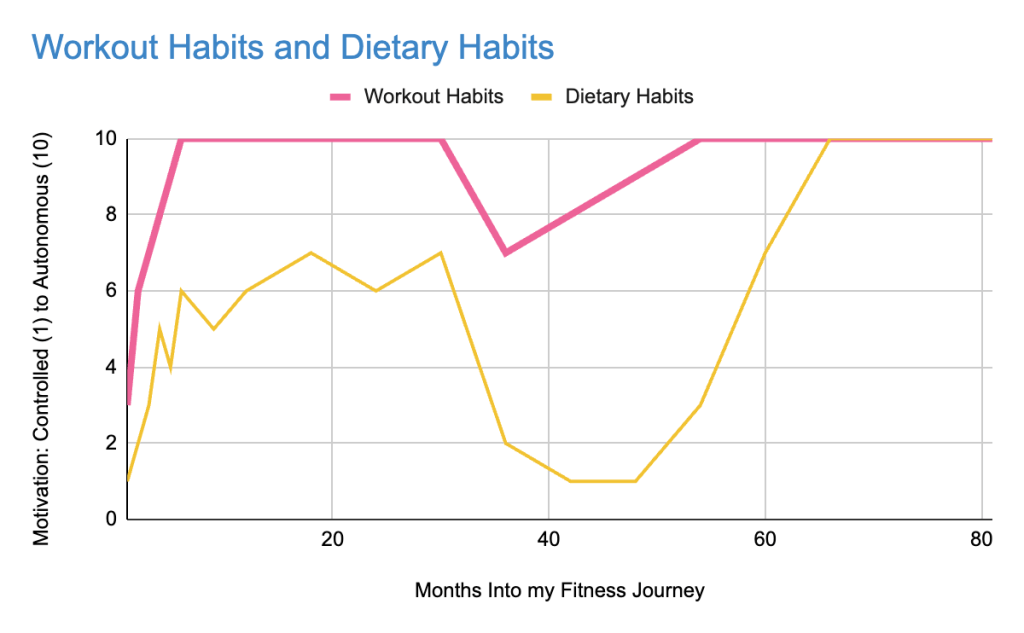
81 months brings us to present day, where I’m not only maintaining a deep love for working out (which I figured out early on and have maintained fairly well), but also for healthy eating (which has put me through some turmoil). We can delve into my fitness and nutrition history another time, but I mostly want to focus on what happened between months ~30-66, because that’s where the most impactful change in my motivation occurred.
Around that 30 month mark, I started to put extreme pressure on myself to look a certain way – the classic introjected motivation trap. Truthfully, I think I just wanted to walk around looking better than everyone else. This selfish desire led me to get into bodybuilding, and I became obsessed with doing everything I could do look a certain way. I still enjoyed training for the most part, and I felt that being strong was part of who I was, so my workouts never shifted far from autonomous motivation. However, I was miserable in my attempts to diet to get shredded. I didn’t enjoy what I was eating, I felt sorry for myself constantly for “missing out” on social events in college to stay on track, and I always complained about how hungry I was. My motivation to diet came from the pressure I put on myself to be a bodybuilder without stopping to think about whether or not bodybuilding was something I enjoyed or identified with. Clearly, this was not sustainable, and after some time, my adherence to my diet dropped until it was nonexistent.

I started to pick the pieces back up when my training, and in turn, my nutrition, morphed into a means for me to explore the world and acquire fun skills. My motivation to train was higher than ever as I learned to fight, cover long distances on my feet, throw my bodyweight around, and (continue to) pick up heavy objects. Most remarkably, my motivation to adhere to a healthy diet transformed as well. My diet was no longer meant to change my body out of pressure to look a certain way, but rather a means by which I could fuel and enhance my athletic performance (identified motivation). Gradually, this grew into me identifying myself as an athlete, and therefore it became natural for me to eat like an athlete (integrated motivation). Finally, I learned to cook high quality, satiating foods that tasted good, and learned to genuinely enjoy eating healthy (intrinsic motivation).
If you have similarly struggled to maintain a healthy diet, workout routine, or other habit, examine your goals. Why are they important to you? Make sure that they A) support the person you want to become or B) are enjoyable for you (bonus points for both A and B). If they are neither, consider if it would make more sense to choose new goals.
Now, once you’ve identified your goals, pinpoint what actions will help you achieve them. Congratulations, you can now lean into identified motivation. The next step is to tie it into your identity. When you take these actions to achieve your goals, who are you becoming? Once you can clearly associate the goal-focused actions that you take with who you are, you’ve achieved integrated motivation. Last, but certainly not least, find as much enjoyment in the process as possible. It may not feel like a party every day (let’s face it, the most rewarding things are the most challenging), but with the right attitude, you can find joy in almost anything. Focus on the little things – the sunrise when you’re out running; the endorphins you get when you lift; the aesthetic of your colorful and nutritious meal on your plate. Once you can cultivate these little delights, well done, my friend. You’ve reached your final form: intrinsic motivation.
Final thoughts.
I hope you’ll take away from this article a righteous indignation every time you see an influencer saying “I wasn’t motivated today, but I did it anyways! *insert nostrils flaring emoji* *insert flexing biceps emoji*”
Just kidding. Let them be blissfully ignorant. You, however, not only know that all action is driven by motivation , but you are also enlightened about the various classifications of motivation. Most importantly, you have the tools necessary to leverage those forms of motivation to work for you on your fitness journey (and on any journey you undertake in life, because #LifeImitatesFitness).
If you’re looking for more direction in setting reasonable, maintainable goals, check out How to actually be successful at fitness.
Ciao!
 The Renaissance Athlete
One thought on “The Truth About Motivation”