

Success in fitness comes at the intersection of what you’re willing to do, what actions get you towards your goals, and what fits your budget, lifestyle, and schedule.
You need a unique approach.
Throughout my fitness journey, I’ve tried hundreds of methods, programs, and regimens to reach my goals, thinking that because someone like Hattie Boydle could get shredded to the bone, then surely, I could follow her approach and I would be, too. At the time, I believed that constant despair and turmoil were just a natural part of the process, and I should keep trying to plow right through a wall that wouldn’t budge. But in retrospect, I can see the full picture – I was trying to fit a square peg into a round hole. Copying and pasting someone else’s method would never deliver me to my athletic promised land. Every person is unique; our motivations, what we are willing to sacrifice, and what we are willing to endure is vastly different from person to person. Therefore, our approach to fitness and wellness also must be individualized.
While this may seem obvious in theory, it’s seldom implemented well. If it were, we wouldn’t have an epidemic of people yo-yo dieting, setting New Year’s resolutions that last less than two weeks, and desperately searching for the next fad fitness trend that will get them fit quickly. The problem is that fitness advice is often given in generalizations. People focus on what they need to implement – what workouts to do, what foods to eat, what targets to hit – rather than how to integrate these elements into a life with millions of moving pieces and a human with thousands of thoughts, dreams, and emotions.
Now we’ve established the problem. So what’s the solution? I’m glad you asked. For all you visual learners out there, I’m going to leave you with an easy-peasy venn diagram:
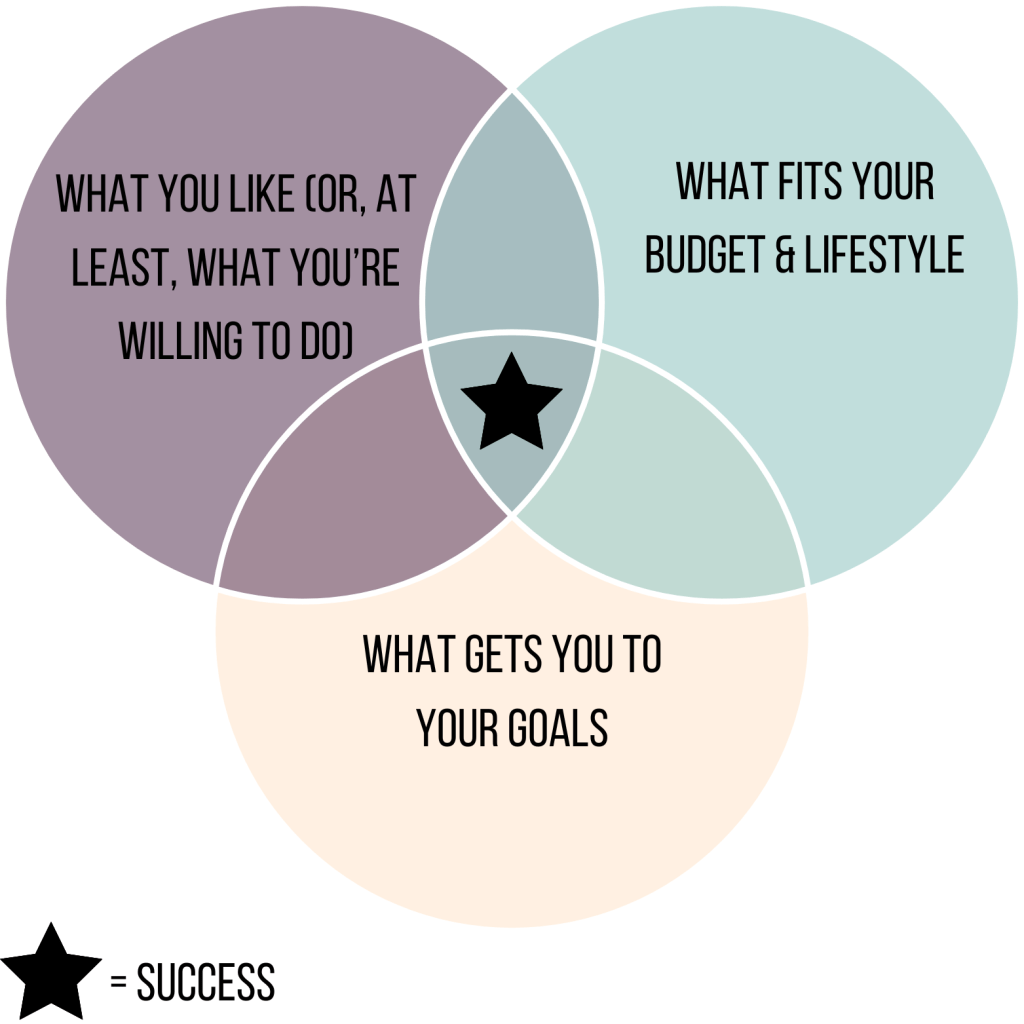
As you can see in the diagram, simply put, success lies at the intersection of what you like, what fits into your life, and what actions get you to your goals. The first two of those items require a great deal of honesty to determine, and the third requires a great deal of knowledge. Coaches often are very helpful with the knowledge piece, but significantly less so with the honesty piece. Can you blame them? Self-honesty can feel messy, uncomfortable, and sometimes, downright painful. It’s not always a fun path to walk someone down. Some trainers even say they only want to work with someone who’s “willing to commit 100%!” to their fitness journey; they just want to preach to you with their endless fitness wisdom and can’t be bothered with the fact that clients are dynamic human beings with unique interests, varying degrees of motivation, and complex lives.
What do you like?
Since there is an abundance of information out there to help with the knowledge leg of the equation, I’ll do my best here to help with the honesty piece, while using some real and raw examples from my own life. We’ll do this by diving deeper into how to determine what you like and what you can fit in your life.
First of all, what do you like? Or, at the very least, what are you willing to do? Some questions that might help you determine this:
- (When do you/What makes you) feel most alive?
- (When do you/What makes you) feel most like yourself?
When you’re answering these questions, it’s important to set aside the expectations that you think other people have of you. Just because your partner, best friends, siblings, parents, etc. enjoy a certain activity doesn’t mean that you enjoy it. Dive deep into your soul, and think back to when you were a child, before the world started influencing your decisions and beliefs. For instance, when I was a kid, I was addicted to adrenaline, and I felt completely at peace in nature. I felt true to myself when I was being tough, brave, and strong. I took pride in suffering and was always ready to throw hands (maybe a little too much so). My favorite places were the barn, the ocean, and the air (climbing and hanging from things was a favorite pastime of mine for absolutely no reason). I also thrived in solitude and embraced the fact that I was a bit of an oddball.
These realizations in my early adult life have led me to slowly unlock a deep passion for the goals I have now. These include doing a mix of adventure sports, water sports, sports with animals, and martial arts, and they are practically all solo sports. I am lucky to have such a wide range of athletic activities that I love and traits that give me a natural affinity to fitness – but rest assured, you don’t need to love doing thirty different sports or activities to have a fitness routine. You only really need one, if that… (more on that later).
However, I wasn’t always crystal clear with myself and peachy with my fitness routine. For many years, I strayed away from what made me feel alive – being wild and alone – and fell into the trap of trying to be what I thought other people wanted me to be. I thought I needed to be attractive to be loved, and that being a fitness model would make me happy. I obsessed over dieting to lose weight, using many different overly restrictive diets that never delivered the kind of change they promised (at least, not for long). Though I did (and still do) enjoy lifting because being strong is FUN, I lifted primarily to shape and tone my body because I thought it would make me desirable. Performing well and using fitness as a tool to explore the world was an afterthought. Even worse than that, my bodybuilding obsession fed into the desire I had to walk around and instantly have something (my physique) to measure myself as “better” than anyone else I encountered. As you can probably imagine, since my motivations were far from pure and my actions were not aligned with a purpose that I truly valued, there came a day when I cracked. The lifestyle I was trying to force myself into crumbled around me, and it sent me on a spiral for a couple years before I finally found a purposeful health and fitness routine, centered around the sports and lifestyle that I truly love.
As promised, we’re going to get back to that “you only need one, if that…” comment from earlier. As you see in the top circle of the venn diagram, I give that caveat of or, at least, what you’re willing to do. While finding something you like to do is preferable, you don’t have to like something to actually do it (stating the obvious here). If you value your goals enough, you will find something you can tolerate and take the action anyways. Hey, I don’t really like doing my dishes, but I value not having fruit flies and mold in my kitchen. So I implement a kitchen cleaning strategy that I’m willing to do. (Redirecting this conversation to fitness before I go off on a tangent about how this diagram pretty much applies to every area of life… food for thought 🙂.)
If you’re having trouble even finding activities that you can tolerate, get curious with yourself about why. Do you have a deep fear of exerting yourself too much? Why? What will actually happen if you do? Start small and build up confidence as you prove to yourself that you can exert yourself without anything catastrophic happening to you. Or, do you just have a bad attitude about it? Do you think that you should be entitled to making the progress you want without doing the work to get there? What can you do to change your perspective? The realization that your own attitude is something you have the power to influence might help to change this.
What fits in your life?
Next up – what can you fit into your lifestyle? It’s important not to underestimate or overestimate. You may be underestimating if you’re thinking I can only work out for 30 minutes per week! but you watch a few hours of TV each week. You might need to be honest with yourself and consider if you can live without that TV time, or if there are places where you can improve efficiency and cut out unnecessary habits to make time to prioritize health and fitness. Furthermore, if you tell yourself that you’re so busy that you have to eat fast food for breakfast, lunch, and dinner, start getting curious about what other options you have. Can you meal prep 2 of those meals on the weekends and have your portions ready for the week? Can you pick healthier options at the fast food places that serve your goals?
On the flip side, it doesn’t serve you to wildly overestimate what you can do. Thinking that you will cook an extravagant, healthy meal for every single meal and work out twice a day for 2 hours when you work 60 hours/week and have a family is not setting yourself up for success. You won’t be able to maintain a healthy lifestyle, while maintaining family and work life, if you set unrealistic expectations for yourself. If you won’t be able to be compliant to your plan 80% of the time, the plan, or the other commitments in your life, will need to be adjusted.
Personally, I’ve struggled with overcommitting, and feeling defeated when I only stay about 50% compliant to my plans. It’s taken some time and maturity to realize that I don’t need to do everything in a given week, especially since I’m not a full time athlete – I value having a dog, living alone, and traveling often, so I work long, hard hours at my job to fund this lifestyle. This comes from accepting that I cannot work out for 5 hours a day and cook a fresh meal for every single meal that I eat, even though in a perfect world, I would.

What serves your goals?
Finally, I will add that honesty, in addition to knowledge, is required when evaluating what will get you towards your goals. If you have a goal to run a marathon in a month but you’re still putting in only 15 minutes of cardio per week, you need to be forthright with yourself and accept that the actions you are taking and your level of commitment does not equal that of someone who is ready to successfully run a marathon. Additionally, if you have a weight loss goal but are overeating on the daily, you must accept that your actions are not aligned with your goal and you require a different approach. If trying to force yourself to eat less food is not something you’re willing to do, start by asking yourself if you are willing to put yourself through therapy and mental healing to evaluate where your attachment to food or fear of hunger comes from, and attack the problem from a different angle.
Make it your own journey.
Ultimately, the possibilities of what your fitness journey could look like are infinite. There is no limit to the number of ways you can incorporate fitness in your lifestyle, and you can incorporate it in a way that works for you. If you’ve tried being honest with yourself but still sense a disconnect or are struggling to give yourself an unbiased evaluation, don’t hesitate to reach out and find a coach that can work through these things with you and help you find that sweet spot of success. Believe me, I know how difficult it is to get back up again and keep fighting to figure out the right plan that balances these three crucial areas. But with the right guidance, support, and habits, it is entirely possible to live the fit life.


Very thoughtful and insightful article!
LikeLike